It's been documented numerous times that the first video game I ever played was the original Sonic the Hedgehog for Sega Genesis. I don't remember much about that early period of my life, aside from being frightened by the Sega chant upon start-up (I have autism, and it didn't stop scaring me until I was thirteen, shut up), but I remember having a Sega Genesis and a Playstation growing up; with a family friend who had a Super Nintendo. Obviously, older titles have that allure that newer games don't tend to share, and it tends to be a very strong allure indeed if the countless retro video game reviewers on Youtube during the early 2000s to now is any indication. Hell, I was an avid browser of the Wii Shop Channel when it was a thing. And now that I've confirmed my age, let's talk about mini consoles.
For those unfamiliar, a Mini Console is a replica of a video game console that contains any number of games pre-installed on the system; think the Super NES Classic Edition or the Genesis Mini. They're typically much smaller than the original versions of these consoles, with a replica controller that mimics a model of a controller from that era. They typically have USB controller ports, though not always, and they're exceedingly simple to set up; a USB cable and an HDMI cable is all you need.
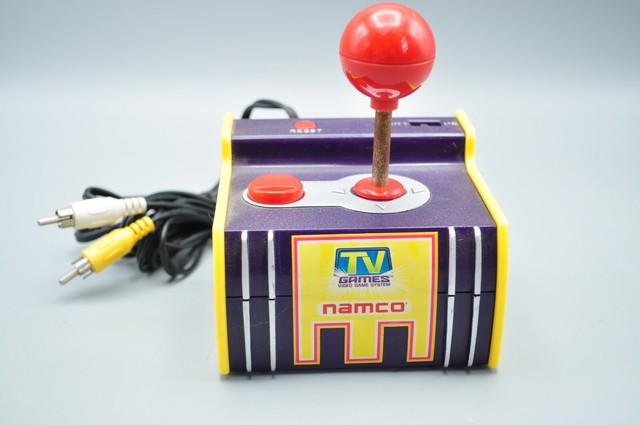
These consoles are the descendants of the Plug-and-Play consoles from when I was growing up, ones that, if they didn't have licensed games that poorly felt like classic games, were emulated versions of these same classic games. one of the earliest I can remember was this one, from Jakks Pacific and Namco (now Bandai Namco):
Jakks Pacific Arcade Classics: Pac-Man 5-in-1
This device contained only five games: Pac-Man, Rally-X, Galaxian (not Galaga, that was the next one), Dig-Dug, and Bosconian; and while the hardware could handly emulated versions of these games, the emulation was more "replica" than true emulation. the Pac-Man title resembles the NES / Famicom version more than the arcade version. The other games are much better played on Namco Museum, which was readily available at the time in numerous places. However, setting this thing up was stupid simple: all you needed to do was hook it up directly to the TV's component input jacks, load some batteries (typically four AA batteries) and flip the switch to on.
I bring this up because I want to talk about three consoles in particular that take this concept and run with it. The Super NES Classic, the Sega Genesis Mini 2, and the PlayStation Classic Edition. This is a small sample size of the overall breadth of mini consoles, and that doesn't take into account the mini Arcade systems from SNK, Taito, and even Sega themselves.
the Super NES Classic Edition has 21 games on it, representing a wide variety of genres and notoriety, mostly focusing on the heavy hitters: first party Nintendo titles (Super Mario World, Super Metroid, Donkey Kong Country); top selling third party games (Street Fighter II' Turbo, Mega Man X, Contra III); some of the most legendary RPGs in the world (Final Fantasy VI, Secret of Mana, Super Mario RPG).
the Sega Genesis Mini 2 is a follow-up system to the original, and while that system focused on the heavy hitters and had games that had appeared in many previous Sega compilations, the Genesis Mini 2 focuses on games that otherwise would never have been given the time of day, mostly playing to the system's strengths: high-octane STGs (Ranger-X, Thunder Force IV); lesser known third party titles (Atomic Runner Chelnov by Data East, Splatterhouse 2 by Namco, Truxton by Toaplan); hard to find collector's pieces (Crusader of Centy by Atlus); in this console, Sega CD games are added to the listing. (Final Fight CD, Sonic CD, Sewer Shark, Silpheed)
the Playstation Classic depending on which region you purchase it from has a different marketing strategy. the Japanese version of the console focused heavily on Japanese made games, while the Western version of the system had a lot of games appealing to America and Europe instead of Japan. either way, you have 20 landmark fighting games (Tekken 3; Battle Arena Toshinden); legendary action games (Metal Gear Solid, Jumping Flash, Resident Evil: Director's Cut); notable RPGs (Final Fantasy VII; Wild ARMs) and awesome puzzle games (Intelligent Qube, Super Puzzle Fighter II Turbo)
The key here is that a lot of the games on these three systems are emulated versions of their original forms, and it's here where the Playstation version falls flat on its face. a good nine games on the Playstation Classic run at PAL speed, which for Americans means they run slower than the NTSC variants. The bigger mark against it is the game lineup.
For the Genesis Mini 2, I can understand it; the point of that system was to put games that many people would pass over initially but were highly received in gaming magazines at the time; however, the Playstation Classic has a lot of games that seem like throwaway picks, especially when so many better games could exist on it: for instance, Ridge Racer Type 4 is a hell of a title, but another good pick would've been something like WipEout, or Rollcage if you couldn't secure the music licenses. Konami's only title is Metal Gear Solid, but they were on a tear at the time. Gradius Gaiden is the only other representation from Konami, and that's on the Japanese system.
What puzzles me is that the Playstation classic could have done so much better with the games it did have. Destruction Derby 2 is a better game overall than the original. Grand Theft Auto 2 is a more interesting game than the original. Resident Evil 2 is more highly regarded than the original, if only by so much. Twisted Metal 2 is better by a country mile than the original game.
The Genesis Mini 2 doesn't have that problem, because it makes every game on it feel unique, even some of the titles aren't that great. Outrunners is a poor port of the Super Scaler masterpiece. Shining in the Darkness is a mediocre dungeon-crawler that definitely requires a more patient and physical touch. M2's work for emulation of older video games is well-documented and well-regarded, and the Genesis Mini 2 is no exception. The original Genesis Mini was made in a response to the AtGames garbage clogging the Mini Console space and giving it a bad name, making a statement that once Sega brought development in house, that it would be a far superior product; for the Mini 2, Sega didn't have anything to prove, they just made the thing and I'm looking forward to their next project.
The SNES Classic is in the same boat. Nintendo already made an NES Classic, which had 40 recognizable NES titles on it. There was nothing left for them to prove; just make a console and bring it to stores in limited quantities (something the Genesis Mini 2 followed suit with, sadly) and then see how many people would buy the thing, which as it turned out was a good million people.
The point is that Mini Consoles, when done well, are an excellent gateway into the libraries of older consoles. the Genesis and SNES Minis do this with an exciting presentation and boppin menu tunes. the Playstation Classic does neither. the Genesis Minis have a variety of titles from all corners of the console's history. The NES and SNES classics have hit games that otherwise would cost a pretty penny in the after-market. the Playstation Classic has... what does it have? Certainly not a worthwhile library without hacking the thing, which would be your best bet honestly. Moreover, these consoles come out at affordable price points. the NES Classic was $60. the SNES Classic and Genesis Mini 1 were $80. the Playstation Classic and Genesis Mini 2 are $100; and certainly there are games on these consoles that exceed the asking price. Especially Crusader of Centy on the Genesis Mini 2; a copy of that game routinely goes for $500 in the after-market.
Should you get one of these consoles? if you can find one for a reasonable price, go for it. They're excellent entry-level consoles, and a great way to kick off your Retro collection. maybe not the Playstation Classic, though.

Comments
Post a Comment